
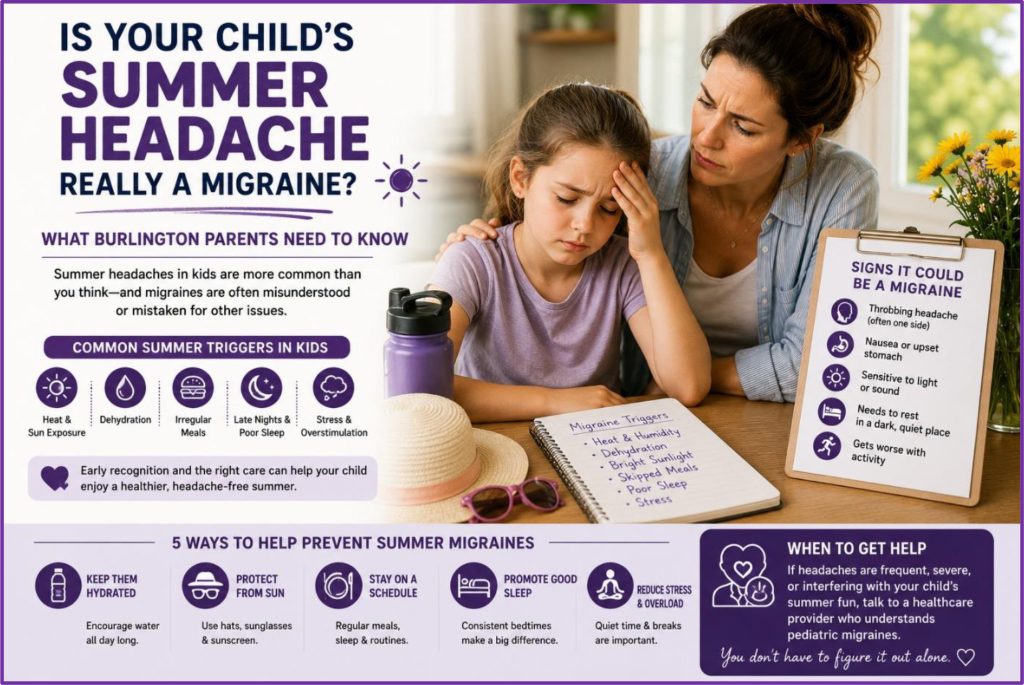
When a child complains of a bad headache on a hot summer day, most parents reach for water and a cool cloth, and that’s a reasonable first response. But when headaches become frequent, severe, or accompanied by nausea, vomiting, light sensitivity, or an overwhelming need to lie down in a dark room, they may not be ordinary headaches at all. Migraine affects an estimated 10% of school-age children and up to 28% of teenagers, making it one of the most common neurological conditions in young people. And summer, with all its disrupted routines, heat, and excitement, is one of the highest-risk seasons for pediatric migraine attacks.
Children’s migraines often look different from adult migraine headache attacks. The pain may be felt on both sides of the head rather than one, episodes tend to be shorter (sometimes as brief as 30 minutes), and stomach pain or vomiting can be prominent symptoms. Some children experience abdominal migraine, a recognized variant involving recurring stomach pain without head pain at all.
SUMMER RISK FACTORS FOR CHILDREN & TEEN MIGRAINES
WHY SUMMER RAISES MIGRAINE RISK IN YOUNG PEOPLE
● Irregular sleep & late bedtimes ● Skipped or rushed meals ● Dehydration from outdoor activity ● Prolonged screen time (gaming, devices) ● Heat & sun exposure ● Emotional stress around transitions
Teen migraines in particular are often dismissed or misattributed to academic pressure or social anxiety. Yet teenagers with unmanaged migraine headache disorder miss more school days, perform more poorly academically, and report significantly lower wellbeing than peers. The summer months, while free of school pressure, introduce their own set of triggers, disrupted sleep from late nights, dehydration from sports and outdoor activities, prolonged gaming sessions, and the emotional stress of social dynamics that intensify when peers are together more frequently.
Keeping a headache diary tracking frequency, duration, symptoms, food, sleep, and activity levels is invaluable for helping a clinician identify patterns and triggers specific to your child.
To book a consultation, call Nabeta Dentistry at (905) 639-6701 or request an appointment online at NabetaDentistry.com/appointment-request. Dr. Jared Nabeta, General Dentist, assesses jaw pain and TMD, including headache related to TMD. Treatment for migraine is offered only for migraine diagnosed by a physician, in coordination with the patient’s physician.