
Dental Implants in Burlington
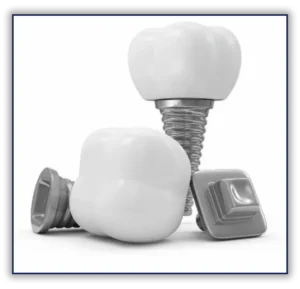 A dental implant is a small post placed in the jawbone to replace the root of a missing tooth. Once it has healed, it can hold a crown, a bridge or a denture. At Nabeta Dentistry, a general dentist assesses whether implants suit you and explains the other options. No referral is needed. Call 905-639-6701.
Reviewed by Dr. Jared Nabeta, DDS, October 2026
What is a dental implant?
A dental implant is a post, usually made of titanium or zirconia, that is placed in the jawbone where a tooth is missing. As the bone heals around it, the implant becomes the base for a replacement tooth.
An implant restoration has three parts:
- the implant, which sits in the bone in place of the tooth root
- the abutment, a connector that joins the implant to the replacement tooth
- the crown, bridge or denture, the part you see and chew with
An implant does not rely on the neighbouring teeth for support, so those teeth do not need to be reshaped to hold it.
What can implants be used for?
Implants can replace a single tooth, support a bridge for several missing teeth, or help hold a full or partial denture in place.
Common uses include:
- replacing one missing tooth with an implant crown
- supporting a fixed bridge where several teeth are missing
- helping a full or partial denture stay in place when you eat and speak
- replacing a tooth that has to be removed because of decay or a fracture
After a tooth is lost, the bone in that area can gradually shrink. An implant may help maintain the bone where it is placed.
Who may be a candidate for dental implants?
Many adults with one or more missing teeth may be candidates, but suitability depends on your health, your gums and the amount of bone available. An in-person assessment is needed to know.
Your dentist looks at:
- your medical history and any medications
- the health of your gums and remaining teeth
- the amount and quality of bone where the implant would go
- habits that can affect healing, such as smoking
- conditions that can affect healing, such as diabetes that is not well controlled
If there is not enough bone, a bone graft may be discussed before or during implant placement. For some people, another option suits better.
What happens at each visit?
Implant treatment takes several visits over a few months. Your dentist explains the plan, risks and alternatives before you decide.
- Consultation and planning: we review your medical and dental history, examine your mouth and take X-rays. 3D imaging may be used to check the bone.
- Implant placement: the implant is placed in the jawbone under local anesthetic. This is done at our office.
- Healing: the bone heals around the implant, often over a few months. A temporary tooth or your denture may be used during this time.
- Abutment and impressions: once healing is checked, the abutment is attached and a scan or impression is taken.
- Final crown, bridge or denture: the replacement tooth is fitted, and your bite is checked and adjusted.
- Follow-up: we check the implant and gums at your regular dental visits.
How long does implant treatment take?
From the first visit to the final tooth, treatment commonly takes a few months. It can take longer if a bone graft or a tooth removal is needed first.
The healing time varies from person to person and from one part of the mouth to another. Your dentist gives you an expected timeline at the planning visit.
What are the risks and alternatives?
Every treatment has risks. Possible problems with implants include infection, swelling, bleeding, an implant that does not bond with the bone, and, less often, numbness from nerve irritation or, in the upper jaw, sinus problems.
Over time, the gum and bone around an implant can become inflamed (peri-implantitis), especially without daily cleaning and regular visits. A crown or denture on an implant may also need repair or replacement in the future.
Alternatives include:
- a fixed bridge supported by the neighbouring teeth
- a removable partial or full denture
- no treatment
Your dentist reviews the risks and alternatives with you, including no treatment, so you can make an informed decision.
How do I care for a dental implant?
Clean around an implant every day, as you would a natural tooth, and keep your regular dental visits. Your dentist or hygienist shows you how to clean around it.
- brush twice a day and clean between the teeth or around the implant once a day
- use the cleaning aids your dentist recommends, such as floss, small brushes or a water flosser
- tell us about any bleeding, swelling or looseness around the implant
How long an implant lasts varies from person to person. Daily cleaning and regular check-ups help.
What does treatment cost?
You receive a written estimate before treatment begins.
Do I need a referral?
No. You do not need a referral for an implant consultation. Implant assessments at Nabeta Dentistry are provided by general dentists. Call 905-639-6701 to book.
Where do our patients come from?
Patients come to us from Oakville, Waterdown, Hamilton and Milton.
Frequently asked questions
Am I too old for dental implants?
Age alone does not usually rule out implants. What matters more is your general health, the health of your gums and the amount of bone available, which your dentist checks at the assessment.
Does getting an implant hurt?
The implant is placed under local anesthetic, so the area is numb during the procedure. Some tenderness and swelling are common for a few days afterward, and your dentist explains how to manage them.
Can implants hold a denture in place?
Yes. Two or more implants can be used to help a full or partial denture stay in place when you eat and speak. Whether this suits you depends on your assessment.
What if I don’t have enough bone for an implant?
A bone graft may be discussed to add bone before or during implant placement. If grafting is not suitable, your dentist explains other options, such as a bridge or a denture.
Can an implant fail?
Yes. Sometimes an implant does not bond with the bone, or the gum and bone around it become inflamed later. Your dentist reviews these risks before treatment and checks the implant at your regular visits.
Do I need a referral for an implant consultation?
No. Call 905-639-6701 to book a consultation with one of our general dentists.